Thursday, August 11, 2016

Slogging through runs in the hot, hot heat

Today in Boston, the temperature climbed to the mid-90s with "oppressive" humidity.


Oppressive or not, there are runs on the training schedule! When I set out for a 17-miler at 6:45 am last weekend, the temperature had already reached 75 degrees and was climbing steadily. It was rough. Training for a marathon through the dog days of summer sometimes feels like an awfully foolish endeavor. Maybe I'm a little scarred by how things went the last time I ran a marathon.

You, too, can look this good!


That's me, laboring through the latter miles of the 2016 Vermont City Marathon. I felt about the way my face looks in both photos.


That's a poor guy whose photo was plastered over the Burlington Free Press the day after the 2016 Vermont City Marathon.

So what's a runner to do? Here are some strategies I use to keep my shit together on the really, really hot runs:

1. I remind myself that the discomfort is not all in my head. The fact that I'm arduously slogging through soupy August runs at paces that felt like a cake walk a mere month ago does not mean I've fallen dramatically out of shape. Increased heat and humidity take a significant physiological toll on the human body. We are gifted with the incredible natural cooling mechanism of perspiration. As sweat evaporates from the skin, it takes heat along with it. But there comes a point when additional sweating doesn't do any good. If the air is also humid, your body's sweat can't evaporate fast enough to keep pace with the rate at which it is generating heat. It quickly becomes difficult to stay cool.

Even if the air is hot and dry, sweat evaporates almost as quickly as it's being produced, putting you at higher risk for dehydration. As the body becomes more dehydrated over the course of a run, your heart needs to work harder to pump blood and your heart rate increases. Heat and sun increase your body's core temperature, with augmented circulation, sweating, and ventilation all contributing to an increase in metabolic demand and making your run feel much more difficult, even at a pace that's typically comfortable.

I try to remind myself that acclimating to unfavorable running conditions is going to improve my efficiency. Kinda like blood doping but without any needles or drugs! I so look forward to that first chilly fall run when I know I'll feel like a total superhero.

2. Hydration is Key. You can lose between 6-12 ounces of fluid for every 20 minutes of running. I pre-hydrate for summer runs by drinking extra glasses of water the night before and gulping at least a full glass before I leave the house in the morning.


On runs lasting an hour or more, I carry water and/or an electrolyte drink with me. I don't wait until I feel thirsty to drink. I take sips every few minutes. Typically, I carry a Nathan SpeedDraw Plus handheld water bottle, which straps to my hand and is relatively comfortable.


Just last week, I purchased a Camelbak Mini M.U.L.E. hydration pack in anticipation of upcoming long runs without reliable known water sources. Yes, this is a backpack designed for a child. It has a 1.5 liter Camelbak reservoir and space for stashing some gear. I've taken it on a few shorter test runs, but will be using it on a long run for the first time this weekend. Full review forthcoming!


I know that the Chicago Marathon will be supplying Gatorade Endurance Formula in Lemon-Lime at aid stations, so I'm beginning to experiment with this sports drink on my long runs to develop a plan for race day that doesn't involve me carrying my own drink. We shall see!

3. I plan my route around the important stuff. I know where all the water fountains (and, let's be honest, the port-a-potties) of Cambridge, Somerville, and Boston are, and I plan my runs to encounter them. Sometimes I plant a water bottle in the bushes outside my apartment and I plan my route in loops so I can stop to take a drink every time I run by. You'd better believe I know which city playgrounds have water sprinklers I can run through. If If I'm traveling, I plan to run by a convenience store or, even better, to end my run at a convenience store where I can get myself a cold post-run Gatorade.

4. I try to run during the coolest parts of the day. I'm a morning person, so a 5 am sunrise run is never out of the question. If I can avoid the hot parts of the day, I do. I know folks who prefer to run after dark, which is also a great way to avoid the hot sun if you're capable of functioning after 8 pm. I'm not. I wear a hat, lightweight, non-cotton running clothes and sunscreen. During the Vermont City Marathon, I put handfuls of ice down my sports bra to keep my body temperature down.

6. I adjust my expectations. I've learned that slowing down in the heat is natural. I try to be kind to myself, running by effort rather than by pace. It's easy to feel discouraged when my Garmin goes off and reminds me that I'm dragging far behind the pace I ran on the same route in April. But I have learned it's important to listen to my body if I want to get through a marathon training cycle intact. My long runs in the heat have been nearly 30 seconds per mile slower than they were in the cool spring, but I'm getting them done and I'm working hard. If all goes to plan, my body will be primed for some excellent fall racing.

7. Take it indoors. Sometimes, it's just too hot to be productive. If I have a hard speed workout on the schedule and the temperature is soaring, YMCA basement treadmill it is. I know the treadmill is loathed by many runners, but I find it has its upsides! A sweat towel, music, and water are all at my fingertips, but I don't have to carry any of them. I can set the pace I'm supposed to hit for an interval and shut my brain off while I run it. If I'm lucky and get my favorite corner treadmill, a massive fan will blow at my face for the duration of my run. What's not to love?

In a perfect world, it would be 50 degrees and cloudy every time I go out for a run. But this is New England, and anything goes. So I'll run for the sprinklers at 5 am with a handful of ice down my sports bra.


For more tips about running in the heat, check out these resources:


UPDATE 8/12: I almost forgot! Olympic Track and Field events start today. Be sure to watch Americans Amy Cragg, Desi Linden and Shalane Flanagan compete in the women's marathon on Sunday 8/14 at 8:30 am EST. Full schedule of Olympic Track and Field events here!


Thursday, August 4, 2016

Race Recap: Vert Sasquatch 2016

As a motor vehicle-less city dweller, my opportunities to run on wooded trails are limited by circumstance. I fell in love with racing on trails at the VERT Middlesex Fells Trail Running Festival last September and have been eager to give trail racing another go at the 5th annual VERT Sasquatch Sprint Trail Race this July.

The VERT race series is put on by the folks at Cambridge 5K. It aims to give runners an opportunity to run on trails that are accessible by public transportation. For me, participating in the series has been a great entry point into the world of trail running. Now I've got the itch to do more trail running and am on the hunt for local trails that can be easily reached by city folk.

Sasquatch is a 2.35 mile "sprint" trail race that takes place in the Whip Hill section of the DCR Middlesex Fells. This year the race was held on a Saturday at 7:00 pm. An evening race on trails, yahoo!

I borrowed my sister's car and drove up from Cambridge to the Stone Zoo in Medford on my own. I arrived nearly an hour early for the race. Feeling unsure about running a short, fast race on trails, I decided to do what any neurotic runner would. I ran the entire course as a warm up.

After five minutes spent taking ginger please-don't-twist-an-ankle steps, I relaxed and began to trust my feet and legs to keep me upright. It was easy to become absorbed in the sensory experience of the wooded trail and I found myself wholly enjoying the alone time, which was over before I knew it.


I arrived back to the parking/start area feeling excited to get racing. To ease course congestion in the race, runners are released in three self-seeded waves at five minute intervals. I positioned myself in the first wave. Hopping up and down, I exchanged nervous words of encouragement with other runners before the starting horn blasted.


The course begins with a left turn out of Greenwood Park onto Pond Street. The first half mile of the course runs along the street, a feature which helped to spread the field of runners. We made a sharp left onto Crystal Springs path and into the dusky, gray woods. Almost immediately, the path ascended a short, steep climb before the leveling off in the woods.


It was a little bit dark and a lot exciting. Bolstered by the new confidence of familiarity with the course and unencumbered by the weight of instinctual self-preservation, I attacked the flat portion of the course and narrowed my eyes to pick off runners as I charged up the second hill.

On the steep downhill section in the final kilometer of the race, I took note of some runners tensing their shoulders, leaning slightly back and tucking their arms as if to brace against gravity. I went with the opposite approach, leaning forward from the hips and allowing my limbs to flail loosely as I hurled myself downward. Looks ridiculous, but feels like flying!


At the bottom of the hill, we emerged back into the park, where we ran one last half lap around a small field to the finish line. I really liked this ending because suddenly I could see all the runners ahead of and behind me and there was a little bit of flat space to sprint.

In the end, I finished 56th overall and 4th among women with a net time of 16:17. No "Top 3" prize, but I'll keep working toward it!


Epic after party performance by the Happy Soles, as per usual.


More trails, please!

Thursday, July 21, 2016

Recipe: Super Seedy Granola Bars For a Festival! (Vegan)


I've got a few race recaps on the docket, but first, there are more pressing matters to attend to: Festival snacks!

The greatest weekend of all the weekends of the year is upon us. It is the eve of the Newport Folk Festival. Although Chris and I will be participating in an abbreviated version of this weekend's events (Chris is in a good friend's wedding on Saturday), we couldn't be more excited to lay out our blanket, drag out our cooler, and soak in the music-filled breeze at Fort Adams on Sunday.


In the spirit of music festival stereotypes, I will share my new favorite granola bar recipe. These granola bars are seriously addictive. As I was packaging them away, I found myself driven to cut off the edges of the "crooked ones" and eat the leftovers. Obviously, all of the bars were "crooked ones".

The recipe is from Dana at Minimalist Baker. It is one of her many simple granola bar recipes and it is full of seeds, sweetened by dates and maple syrup, and so very good. I didn't change much from her original recipe. I simply added dried tart cherries and chopped dark chocolate and I cut the bars into smaller servings than suggested.

Super Seedy Granola Bars
adapted, very slightly, from Minimalist Baker

Ingredients
  • 1 1/2 cups rolled oats
  • 1/2 cup raw almonds, roughly chopped
  • 1 heaping packed cup medjool dates, pitted
  • 2 Tbsp chia seeds
  • 2 Tbsp sunflower seeds
  • 2 Tbsp flax seeds
  • 2 Tbsp hemp seeds
  • 1/4 cup maple syrup
  • 1/4 cup creamy salted natural peanut butter or almond butter (I used Teddie peanut butter)
  • 1/3 cup dried unsweetened tart cherries (optional*)
  • 40g (1.4 oz) chopped dark chocolate (optional*)

Instructions
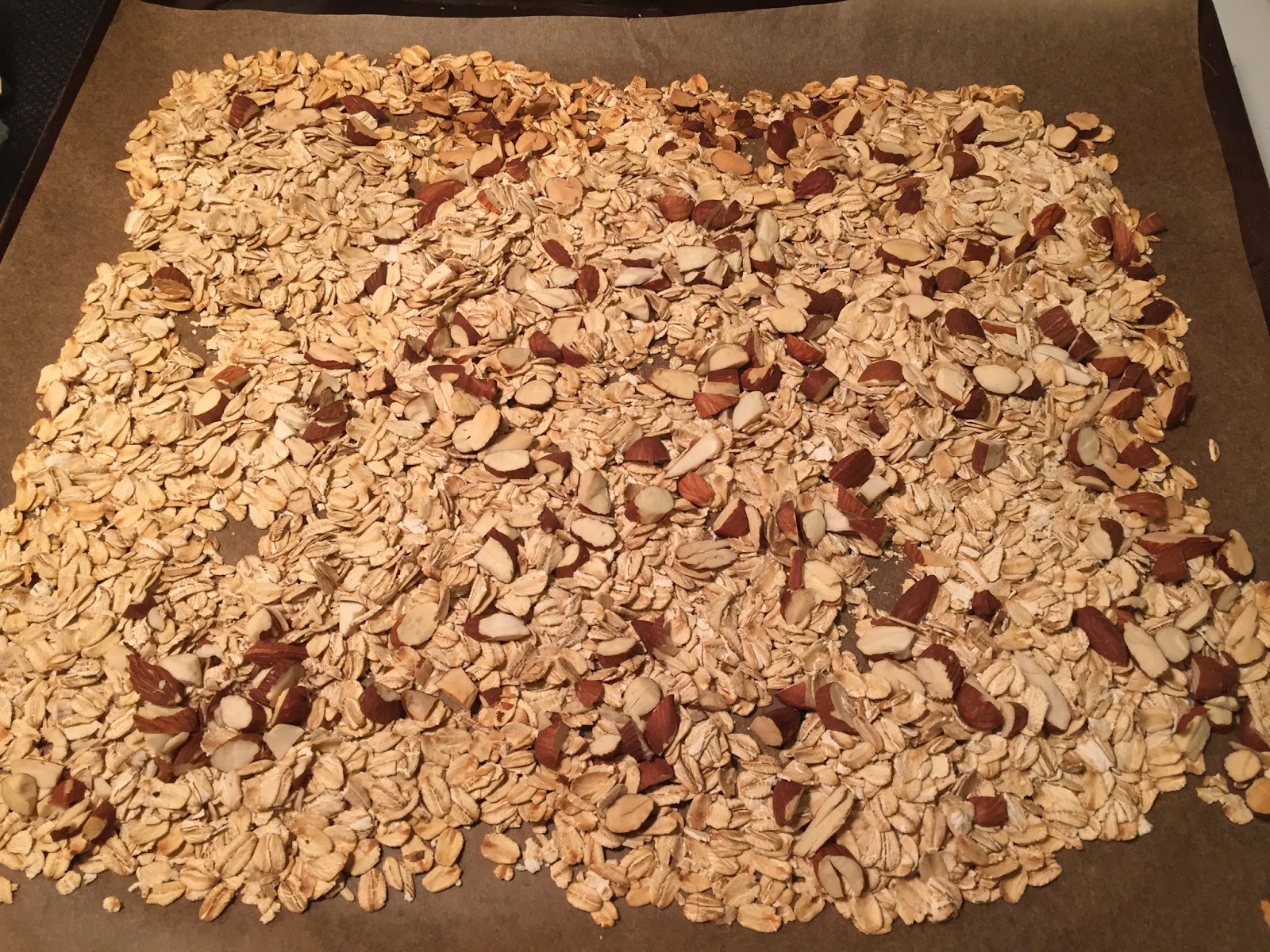
  1. Toast your oats and almonds in a 350 degree oven for 13-15 minutes or until slightly golden brown. 
  2. Process dates in a food processor until small bits remain (about 1 minute) and dates have a dough-like consistency. Mine rolled into a ball.
  3. Pour oats, almonds, and dates into a large mixing bowl. Add all of the seeds and set aside.
  4. Warm maple syrup and peanut butter in a small saucepan over low heat. Stir and pour over oat mixture and then mix, breaking up the dates to disperse throughout. Use a spoon or your hands to thoroughly mix. Add in cherries and chocolate and mix again until evenly distributed.
  5. Transfer to an 8x8 dish or other small pan lined with plastic wrap or parchment paper so they lift out easily. I only have a 9x13 pan, so I used 2/3 of the pan. 
  6. Cover the mixture with parchment or plastic wrap and press down with something flat, such as  a book, to get them flat and packed tight. This will help prevent them from crumbling. Chill in the freezer for 15-20 minutes to harden. 
  7. Remove bars from dish and chop into 20 even bars (the original recipe called for 10, but I like smaller snack-size bars. Store in an airtight container for up to a few days. I like them best straight out of the freezer.
* You don't need the dried fruit or chocolate, but I think they taste excellent. You could substitute in raisins, dried cranberries, etc. Although I chopped up a dark chocolate bar I had hanging out in my freezer, you could also use vegan chocolate chips, etc. 


Newport, we're ready for you!

Monday, July 11, 2016

Race Recap: B.A.A. 10K 2016

When my husband mentioned he'd like to try running a 10K race, I feigned nonchalance in hopes that my overeager excitement would not deter him. I'm certain my giddiness was thinly veiled. Within minutes, I had Googled and emailed him the link to register for the 2016 Boston Athletic Association 10K on June 26, 2016.

I avoid the really, really big races. I am drawn to the community atmosphere of small events. The logistics are usually easy, the price tag tends to be cheaper, and there is sometimes a chance I will place among women in the race. I am SO not above signing up for tiny races so that I might win a prize.

Signing up for a very official and very serious race with a $48,500 prize purse felt intense and also exhilarating. The Boston Athletic Association is the organization behind the famed Boston Marathon, and they are no ordinary Mom and Pop race organizing group. With 7,811 runners, including many who run professionally (like for a living!), this was the largest event I'd ever run in.

In what sport other than running do I have the opportunity to compete against the most elite athletes in the whole sport?

The Course
The B.A.A. 10K is an out and back course in downtown Boston. It starts and ends on Charles Street between the Boston Common and the Public Garden. The course travels west up Commonwealth Avenue to the campus of Boston University, where a hairpin turnaround brings runners back toward the Common. This provides a rare opportunity for us human runners to pass by the superhuman front runners blazing their way back toward the finish. There were water stations at each mile and one Gatorade station at Mile 4.

Pre-Race
Chris and I rode our bikes together from home to the Boston Common. We locked up and walked over to the duckling statues in the Public Garden, where other runners from Slumbrew Happy Soles were congregating before the race. We found my sister, Carly, and paced around for a few minutes, but I was too nervous to stick around for the group photo, so I jogged off to use the port-a-potty and warm up in the corral for a few minutes. It was a hot morning, and I'd decided I wanted as little sweaty material on my skin as possible...but I've never run in sports bra sans tank top before. I felt pretty awkward about it. Moments before the start, I yanked off my throw away t-shirt and tucked it into a garbage bin.

The Start
There were official signs lining the fencing of the corral to help runners self-seed based on projected pace, but the times were printed so they faced toward the outside of the fence. Most folks were loading in from the front of the corral and didn't have a clear view of the signs, so it seemed we were just trying to make room for one another wherever we could fit. It was jumbly, so I pushed forward as best I could.

In effort to ease congestion, the B.A.A. 10K has a "pulsed" start, meaning runners are released in 4 groups over several minutes. Each runner's chip begins timing when he or she crosses the start line, so there is no penalty for starting in a later pulse. I aimed to position myself to start in the first pulse so I could maximize space and try to keep up with the fast pace set by runners I have no business chasing. As we waited, the elite runners were introduced and a woman sang the national anthem.


Miles 1-3.1
The first mile of the race was quite crowded. Though the street had been closed off, there were cars parked on both sides and runners dodged around cars, pot holes, and each other to carve out some elbow room. I noted there were both mile markers and kilometer markers on the course, and I fixed my brain on calculating the differences between the two as a way to distract myself from the discomfort of the fast start. I settled in to steady breathing, running with some restraint as I assessed the effect of the beating sun.

After passing the 2 mile marker, we turned out from the Back Bay neighborhood onto Commonwealth Avenue and began climbing toward Boston University. A man shifted next to me. This was the out-and-back section of the race where we'd glimpse faster runners on their return leg. "Have the front runners already passed?" he asked. I pointed to the flashing lights of the pace car coming down the hill ahead. Holy cow! They were blazing. First the men passed by, then the women. Hometown hero Shalane Flanagan, who is headed to the Rio Olympics next month to represent the USA in the marathon, was leading the pack by a stride. I whooped for her.


"You know, there are only a few cones between you and the elites," my new companion observed. "You could totally Rosie Ruiz it." I smirked and he drifted ahead a few steps, but I resolved to keep him in my sight line. Now I had someone to beat!

Miles 3.1-6.2
We hit the turnaround at 5K and I was eager to cruise back down the hill. I allowed myself to pick up the pace a little here, enjoying the relief of descent. There was one more small hill as we dipped under the Massachusetts Avenue overpass. We neared downtown and passed a sign that read, "800 meters to go!" I did a quick self-assessment and cranked it up. We rounded the corner onto Boylston Street and I judged that I had about 400 meters left. Time to dig in! I caught my Cheat-To-Win encourager, and he shouted, "Great kick!" as I passed.


I finished the race in 43:16 for a split of 6:57/mile. Though I'd hoped to run a few seconds faster, it was still a PR and I'm pleased that I remembered how to run hard on a hot day. I might be feeling a little scarred by my recent marathon in hell.


After catching my breath, I snagged a water and a banana in the massive, impeccably organized finish area and watched from behind barriers at the finish line for Chris and Carly. Since this was the first ever 10K for both, automatic PRs all around!

Chris finished in 57:24 looking strong and relaxed. (That's him in the teal and black.)


Carly finished in 59:48, and I couldn't find her at the finish line for a photo.

I learned that Shalane Flanagan had gone on to win the race - and set a new American Record. She finished in a mind-blowing 30:52. Daniel Chebii of Kenya won the men's race in 27:55.


We snapped a photo with our new medals, pocketed some free snacks, and picked up our t-shirts.


Check out this highlight video of the women's race from the B.A.A. website. Like I said...in what other sport can I just casually sign up online to bike down the street and compete against the most elite athletes in the world?! This was a really cool experience. Go Shalane! I'll be cheering for you in Rio.

Related Posts Plugin for WordPress, Blogger...